Benefacts was incorporated in Ireland in 2014 as an independent nonprofit (limited by guarantee without share capital) company. Its mission was to deliver public transparency and digital accessibility to Ireland’s €14bn nonprofit sector.
Its voluntary Board was drawn from the nonprofit, public administration, professional services and philanthropy sectors and it had a professional staff of 15 FTEs with technical expertise in data production and engineering, financial analysis, nonprofit governance, web development and project management.
With an average turnover of €1.3m per year between 2015 and 2021, Benefacts was established at the request of the Minister for Public Expenditure and Reform following the success of an earlier pathfinder project (Irish Nonprofits Knowledge Exchange or INKEx). It was co-funded by State grants (66%), philanthropic donations and service fees (33%) until 2022 when the company was wound up following the discontinuation of the Minister’s support.
After March 2022, with exclusively philanthropic support, a group of Benefacts’ former directors and staff established a small company to act as a legacy vehicle for the project – stewarding its residual IP and other assets, and engaging with prospective partners on the continuation of its work. That company (Benefacts Legacy DAC) produced two iterations of the Directory of Irish Nonprofits in 2022 and 2023, and produced this website. Benefacts Legacy DAC itself has now wound up its activities.
Project Origins
Benefacts began life as a transnational European feasibility research project. In 2007, working with Guidestar International, sector lead bodies in five European countries set out to explore the potential for a different approach to building and sustaining a nonprofit knowledge infrastructure, using public data re-use processes originally developed in the USA by Guidestar. Co-funding for the 19-month project in Ireland was provided by the European Commission, national governments and philanthropies.
The proof-of-concept research partners were
- Irish Charities Tax Research CLG (now Charities Institute Ireland)
- German Central Institute for Social Issues
- Nonprofit Information and Training Centre Foundation (Hungary)
- Central Bureau on Fundraising (CBF) ( Netherlands)
- Guidestar UK (wound up in 2010)
The multi-national pilot project was studied in detail by this report prepared in 2009 by the European Center for Nonprofit Law.
Following the proof-of-concept project, in 2009 the Irish government’s Department of Community, Rural & Gaeltacht Affairs – which was also responsible for charity regulation – made a 3-year grant to support the establishment of GuideStar Ireland (incorporated as Irish Nonprofits Knowledge Exchange or INKEx) as a nonprofit company. Co-funding was provided by philanthropies. Recognising the tell-us-once value of the Guidestar data harvesting model, the Charities Act was amended to include a provision “to ensure there will be no impediment preventing the authority, under direction of the Minister, from engaging with an external data provider such as a future GuideStar Ireland with regard to the provision of material to assist in maintaining the register of charities.”
Proof of concept
INKEx demonstrated the functionality of the data re-use model between 2009 and 2011. The company built systems for routinely harvesting and processing data about nonprofits from multiple Irish regulatory sources and began publishing this on a free searchable public website in 2010. In 2011, given economically straitened circumstances and the decision to defer the establishment of a regulatory authority under the Charities Act 2009, State funding for INKEx was withdrawn and following negotiation of redundancy costs, the company was wound up the following year, despite the case made for continued State and philanthropic support. View INKEx Directors’ Report and Financial Statements for 2009, 2010 and 2011.
To disseminate the data accumulated by the project, philanthropies and sector lead bodies provided financial support for the production of an analysis report Irish Nonprofits_ What do we know? and to safeguard its data and other intellectual assets INKEx’s directors placed these into a private trust for safeguarding.
Building the Irish Nonprofits Database
Work on the Irish Nonprofits Database resumed following a request in 2014 from then Minister for Public Expenditure and Reform, who asked the INKEx trustees to reinstate the Irish Nonprofits Project. As explained by Benefacts Chairman in later correspondence with the Oireachtas Public Accounts Committee, this was conditional on:
- match funding being secured from philanthropic sources
- the company being established on not-for-profit terms
- compliance with best practice governance standards,
- all of the data being published at no charge
A new company was incorporated at the end of the year and shortly afterwards adopted the name Benefacts. 3-year grant agreements were duly made with The Atlantic Philanthropies (€1.6m), The Ireland Funds (€0.4m) and the Department of Public Expenditure & Reform (€2m). In March 2015 the company began to recruit its professional team.
Benefacts asked its three co-funding stakeholders to express their respective goals for the project. They said – to varying degrees – they expected it would promote public information and understanding about the work of the sector, promote public confidence and trust in nonprofits, provide policy intelligence, promote e-governance including “tell-us once” solutions, provide business intelligence and help to promote Government’s public sector reform agenda. Here’s how each funder weighted their priorities.
Corporate and project governance
Benefacts established corporate and project governance arrangements with its respective funders and other stakeholders. Its Board included individuals drawn from the nonprofit sector, from philanthropy, professional services (IT, financial accounting, law) and from serving and recently retired public servants. The Managing Director served as a member of the Board.
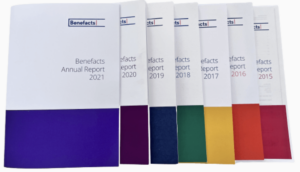
You can view Benefacts’ own corporate reports and financial statements here – for 2015, 2016, 2017, 2018, 2019, 2020, 2021 and 2022.
Over the following eighteen months the company recruited fifteen full-time equivalent staff with specialist knowledge, experience and qualifications in nonprofit sector governance, project management, database engineering, data production, financial accounting, and web production.
Two stake-holding forums were established by agreement and met regularly. A project advisory group was established by the State funder under the terms of its funding agreement to ensure the project was aligned with public policy, and to socialise it across the public service. Participants included representatives of State bodies (Government departments, regulators, agencies, offices) and co-funding philanthropies.
Benefacts stakeholders forum was drawn from representatives of the sector including lead bodies and research interests. It provided an opportunity to explore questions of definition (conditions for inclusion in the database, classification), and provided a platform for discussing concerns and ideas for deployment of the data from the perspective of civil society organisations. In 2017 it transitioned to an editorial oversight group in support of Benefacts analysis and reporting projects.
Project Funding
In 2018, following a project review and evaluation, the State funder made a second 3-year funding contract with Benefacts, augmented in 2019 by a new funding oversight agreement including a requirement that Benefacts comply with the Code of Practice for the Governance of State Bodies. The Ireland Funds likewise committed to a second round of grant support but the Atlantic Philanthropies confirmed that under its pre-existing spend-down plans, there would be no further funding from that source.
The new funding agreement allowed Benefacts to seek funding from other State sources for the provision of data, analysis or intelligence services so long as it continued to fulfil in full its free services to the Department of Public Expenditure & Reform, the Central Statistics Office and Revenue. In Ireland, the State through its public sector bodies (PSBs) – Government departments and agencies – is the largest single source of nonprofit funding.
Benefacts devised and secured co-funding from six public sector bodies for a customisable data analytics solution, focussed on policy analysis and financial management requirements. To ensure no procurement regulations were being breached, the principal State funder commissioned an external report into the State’s requirement for nonprofit data. It asked other State bodies to be scrupulous in complying with normal commercial procurement rules in relation to any work commissioned from Benefacts, which now received more than 70% of its funding from the State. In the event there was no open procurement process, and Benefacts was no longer invited to attend meetings of the cross-agency project advisory group established under the terms of its funding agreement with the Department of Public Expenditure and Reform.
Business model
After 2018, Benefacts looked for ways of diversifying its income. In 2018/19, in cooperation with six public sector bodies (PSBs) Benefacts devised, tested and launched Benefacts Analytics as a proof of concept service. This was designed to be a scalable service delivering customised data and analytics to registered users in each partner (two central government departments, two State agencies and two local authorities), using data derived from the regulatory filings of their respective grantees and from other State bodies. The model could equally have been used by private philanthropies. An oversight group of the co-funding partners was established, and noted the progress made over the 18 months of the project in an outcome report.
Benefacts Analytics provided registered users in each participating PSB with current and historic (five years) of employment, remuneration, State grants (all sources), financial, regulatory and governance data and analysis otherwise unavailable in this aggregated and digitised form. View some illustrative screengrabs to see the kind of data, analysis and analytics offered to one trial user (Kildare County Council).
In 2019 Benefacts made a service agreement with Tusla – the Child and Family Agency to make Benefacts Analytics part of their routine financial monitoring, control, and risk management processes. In 2020, responding to a suggestion from one of the partner institutions, Benefacts published its Who Funds What database in a standalone website – initially available only to public servants, and later (following a feedback report) to the public.
Public bodies in Ireland (and nonprofits receiving most of their funding from the State) are required to follow Public Procurement Guidelines in commissioning goods or services, and are encouraged to support SMEs in offering contracts. Typically, larger consultancy and research services are procured by State bodies through framework agreements with established consulting firms, or from non-commercial State-controlled companies that are exempt from normal procurement rules under Section 12 of public procurement regulations. As it was neither an established consulting firm nor a State-controlled body, Benefacts was unable to access these sources of service contracts, although it asked its lead State funder to consider re-establishing it as a Controlled Public Body under EU Rules.
No action to change Benefacts legal status or funding model was taken, but between 2016 and 2021 the company fulfilled more than 80 individual data and analysis commissions for public bodies, nonprofits and private firms, and initiated a series of specialist analysis projects with co-funding from philanthropies.
Wind-up
Having commissioned an external report on the market for nonprofit data in mid 2019, the principal State funder was advised that the services devised and provided by Benefacts were indeed seen to be of high value by public sector bodies. The authors recommended that the services be continued either by central Government, or commissioned externally following “a well-managed open procurement process” in which they assumed Benefacts would be able to participate.
In the event there was no open procurement process. According to correspondence disclosed under FOI, Pobal – which is a nonprofit agency that works on behalf of the Irish Government to support communities and local agencies toward achieving social inclusion and development, and which is exempt from the usual provisions of procurement regulations – expressed an interest in assisting the Department of Public Expenditure & Reform in this regard. The following year the Minister for Public Expenditure and Reform decided to terminate funding for Benefacts and the Taoiseach – whose department has responsibility for Ireland’s independent national statistics service – said that neither his nor any other department would take on a lead role in its funding.
In a proposal to a consortium of State funders, Benefacts sought to diversify funding across public sector bodies availing of its services, or alternatively to be treated by Government as a controlled body.
These efforts failed and despite the offer of continued philanthropic support, State funding to the company was terminated under a final agreement between DPER and Benefacts requiring its wind-up. All of the staff were made redundant, the data files were lodged with the Irish Social Science Data Archive, and the residual intellectual assets (of no commercial value) were transferred to a separate nonprofit company – Benefacts Legacy DAC, governed by a group of Benefacts’ former directors and managers.
Once Benefacts was extinguished, a spokesman for Government told an Oireachtas committee that the Central Statistics Office was seeking alternative means of producing the same data and another Government Department was considering a replacement data service. Answers to questions posed in the Oireachtas (including its Committee of Public Accounts) and correspondence with the Committee suggested that steps were actively being taken to address in part the vacuum created by the termination of Benefacts work. Three years after the wind-up of the company in March 2025, none of the public data, information or intelligence services provided by Benefacts had yet been re-instated.
Legacy
Benefacts Legacy DAC was established to steward Benefacts’ residual assets, preserve its legacy and reputation, republish its datasets and reports, and cooperate with anyone who shared its values to explore ways of using the project’s intellectual assets for the benefit of the nonprofit sector and its stakeholders.
With funding from a group of Irish and international philanthropies, a standalone Directory of Irish Nonprofits was published by the company using fresh data in 2023 (for 2022) updated in 2024 (for 2023).
Discussions with non-governmental funders of the sector to transfer the company with its intellectual and technical assets to a consortium of philanthropies and social finance providers did not mature, and at the end of 2024 the legacy company was in turn dissolved, following a resolution of the directors to publish these assets on this website.