Benefacts built the Database of Irish Nonprofits and maintained it live between 2015 and 2021 by daily harvesting, normalising and amalgamating data on more than 20,000 Irish nonprofits from their regulatory disclosures.
In 2022 and 2023, the Benefacts legacy project produced more limited datasets, maintaining the directory of all Irish nonprofits – however regulated – in those years.
You can access these Benefacts directories and datasets here. Personal data has been removed. Your use of these datasets is governed by the associated licenses, which reflect the re-use of public information license terms under which Benefacts sourced the public data in the first place. Users should include, or link to, this attribution statement: “Contains Irish Public Sector Data licensed under a Creative Commons Attribution 4.0 International (CC BY 4.0) licence”.
Read about the processes used to create the database, and learn more about the analysis reports derived from it while Benefacts was active between 2015 and 2022.
Benefacts Data Directories 2015 – 2023
By identifying all the nonprofits registered by Irish State authorities, Benefacts created a base register of the sector, maintained live and freely published online.
Between 2022 and 2024, with support from a group of Irish philanthropies, Benefacts Legacy DAC updated this directory as a searchable, sortable and filterable dataset to provide the sector and its stakeholders with an updated classified list of regulated nonprofits in Ireland.
- Directory of Irish Nonprofits 2023
- Directory of Irish Nonprofits 2022
- Directory of Irish nonprofits 2015-2021
Benefacts Financial and Governance Datasets
Benefacts Data on State funding for Irish Nonprofits in 2020
Benefacts “Who Funds What” was a free public website website that reported itemised State grants of €7.4bn to 2,416 Irish nonprofits in 2020 under 47 distinct grant programmes. Access the State grants data here.
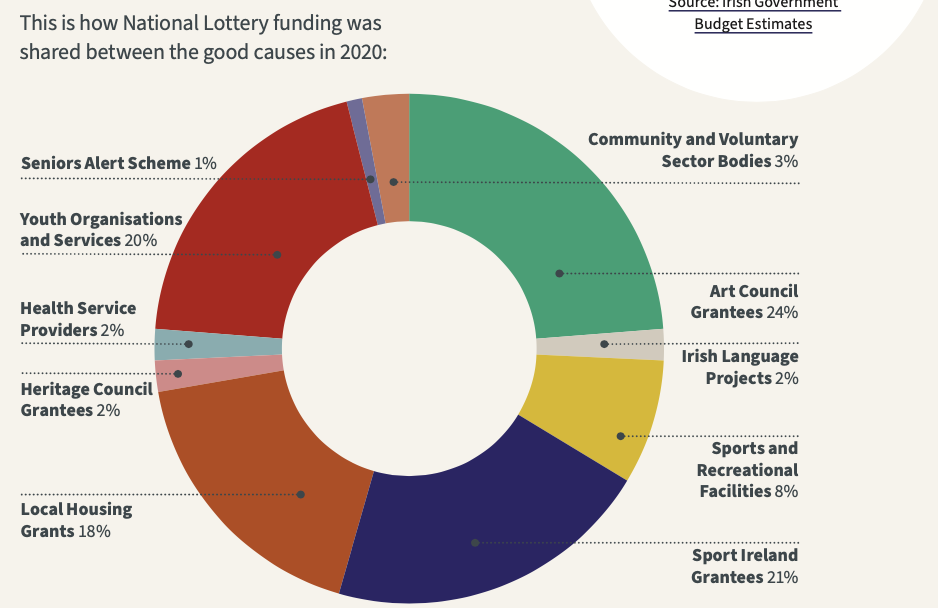
A version of Benefacts Who Funds What was created to provide information on 2,036 Irish Nonprofit organisations part-funded in 2020 by the proceeds of the National Lottery under 35 grant programmes. Access the data on grants part-funded by the National Lottery.
All of the public data in these files was accessed under the provisions of open data re-use regulations. In reusing the data you are in turn indicating your assent to the terms of the Irish Government’s open data license.
While all reasonable care was taken in the preparation and completion of these datasets using documents retrieved from regulatory sources (including financial statements prepared by third parties) and input by Benefacts into its database, Benefacts, its successors and assigns did not guarantee the accuracy or completeness of the information contained in it and could accept no responsibility for errors or omissions.
Data as a service
Between 2016 and 2022, Benefacts responded to requests to provide data as a service to the public and, to support the business processes of four State institutions. These services were all terminated when Benefacts was wound up in 2022 and are no longer available.
Benefacts.ie
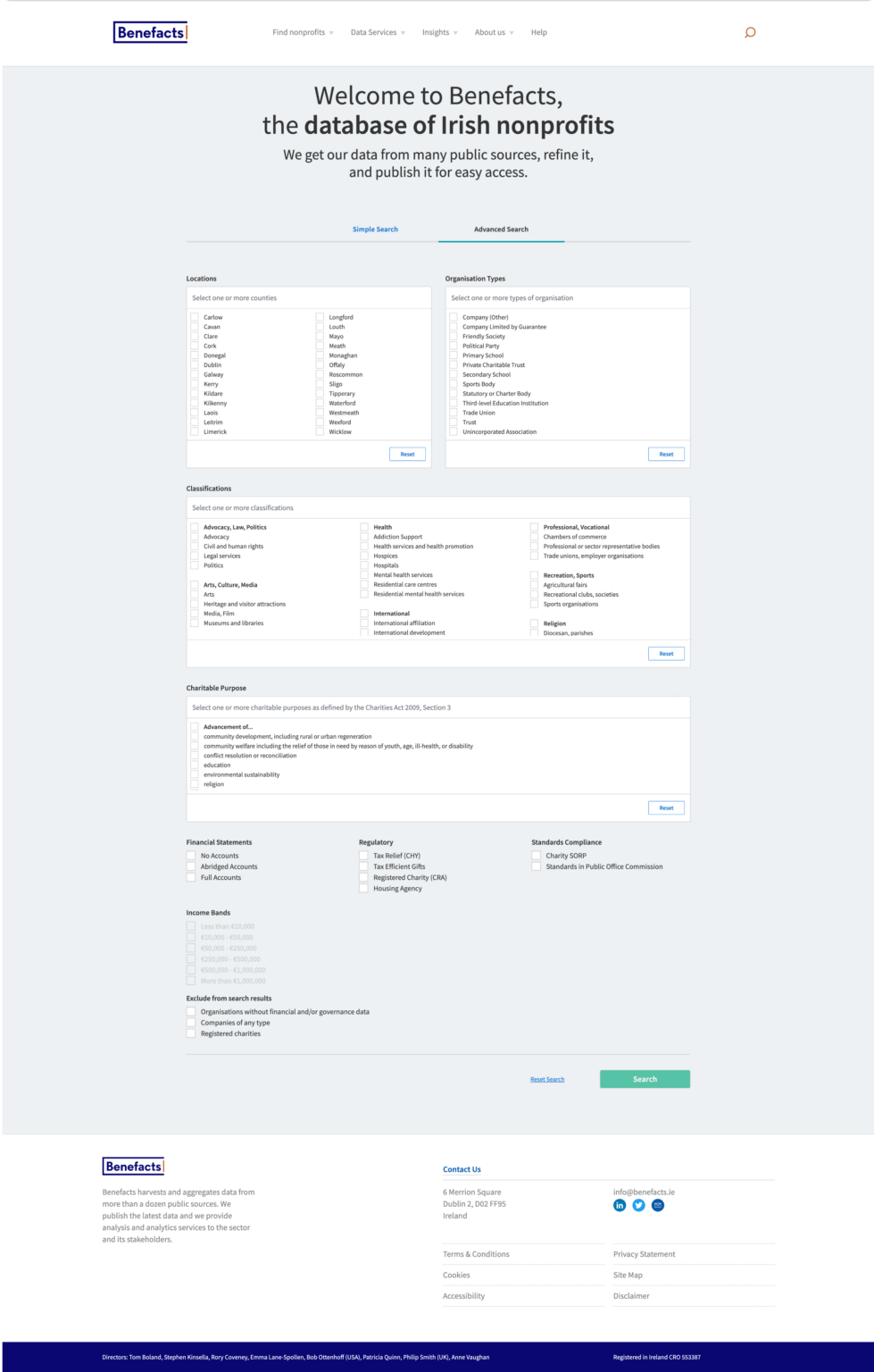
Each listing included more than 100 fields of directory, classification, governance, narrative, employment, regulatory, governance (directors’ names and dates of service) and financial data including an analysis of financial income (grants/earned/other income from all sources) and charity tax status. Source documents (constitutions, financial statements) were freely provided.
About 10,000 people a month used the site’s search, filter, sort and download functions including nonprofits, policy-makers, philanthropies, researchers, journalists, professional service providers and members of the public.
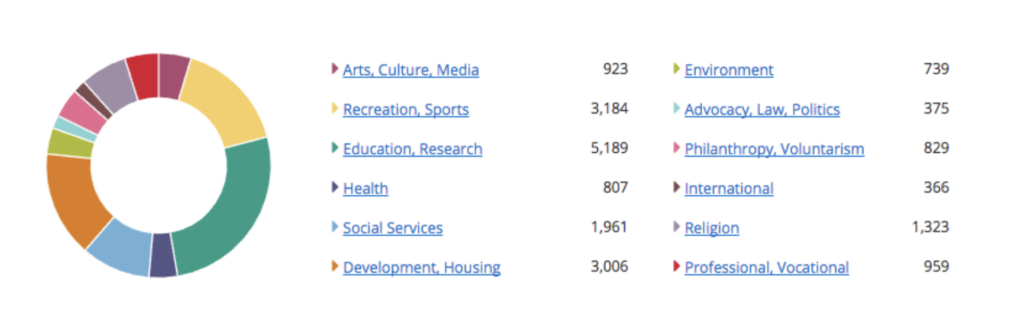
Benefacts Who Funds What
A searchable database itemising State grants to nonprofits. Between 2020 and 2021, using data derived from the published and voluntary disclosures of Public Sector Bodies, Benefacts developed two new websites.
Benefacts Who Funds What provided an analysis of €7.7bn In State grants under 47 individual grant programmes to nearly 3,000 itemised nonprofits in 2020. Benefacts built a similar website showing how the proceeds of National Lottery funds were directed by Government in 2020.
Anyone could use the websites to:
- track multiple State grants to the same nonprofits
- learn more about each publicly-funded nonprofit by linking to its listing on benefacts.ie.
- sort grant information by scale, location, funder, grant programme or regulatory status
- download files to study the data offline
A ‘base register’ of Irish nonprofits
- for data.gov.ie – the Irish Government’s Open Data Portal, Benefacts provided a regulatory data file updated weekly by way of API at the request of the Department of Public Expenditure & Reform. This included the name, address and regulatory ID of every live entity in its Database of Irish Nonprofits, plus a Benefacts-assigned ID, a sub-sectoral classification code and Eircode.
A trusted data supply for Ireland’s national statistics office
- For Ireland’s National Statistics Office (the CSO) Benefacts provided a quarterly updated file including all of the regulatory, employment and financial data on every nonprofit in its database, under the terms of an agreement with the CSO which used it used in the preparation of Ireland’s National Accounts. Information about Nonprofit Institutions Serving Households is a mandatory reporting requirement on all European national statistics offices. The CSO’s Director General explained the value of this otherwise unavailable dataset in correspondence with a Committee of the Oireachtas, which decided to publish it.
A data service for Ireland’s Revenue Commissioners
- At the request of the Revenue Commissioners Benefacts provided an API linking Revenue’s analysts with the live data published in each nonprofit’s listing on benefacts.ie
An analytics service for Public Sector Bodies
In an 18-month proof of concept project co-funded and co-produced with six Public Sector Bodies 2018/19, Benefacts built, tested and launched a customised data analytics tool for registered users per client agency.
Benefacts Analytics provided hundreds of fields of financial, governance and regulatory data and analytics over five years for the distinct set of nonprofits funded per PSB, and was used to facilitate compliance reporting, due diligence and risk management. The outcome report lists the data fields provided per client.
As an outcome of the project, Benefacts entered into a year-round contract to provide this service to Tusla – the Child and Family Agency.
About Benefacts database
In pursuit of its mission to make Irish nonprofits more transparent and more digitally accessible, Benefacts set out to create a high quality set of trusted data, impartially created and neutrally presented, using open data regulations and IT tools available to any Irish citizen. As an independent nonprofit organisation, Benefacts had no regulatory mandate, powers or responsibilities.
In a data dictionary produced for its service users, Benefacts published a list of the 600 core fields in its Database of Irish Nonprofits. These were chiefly data derived from public records including data derived from regulatory disclosures (financial statements, constitutions) of nonprofit organisaitons of all kinds. For validation and analysis purposes Benefacts added its own unique ID, and classified every entity in the core database.
Benefacts processed and stored the data, published updates on its free public website benefacts.ie, and provided it as a service to others in various forms. It also used the data to create a series of information, analysis and analytics services.
For special projects – like Benefacts Analytics, reports on charitable and philanthropic giving, Benefacts Who Funds What – Benefacts created additional datasets. Some of these – like grant expenditure disclosures from State bodies – used public data. In other cases, such as the analysis of philanthropic giving, Benefacts relied on non-public disclosures.
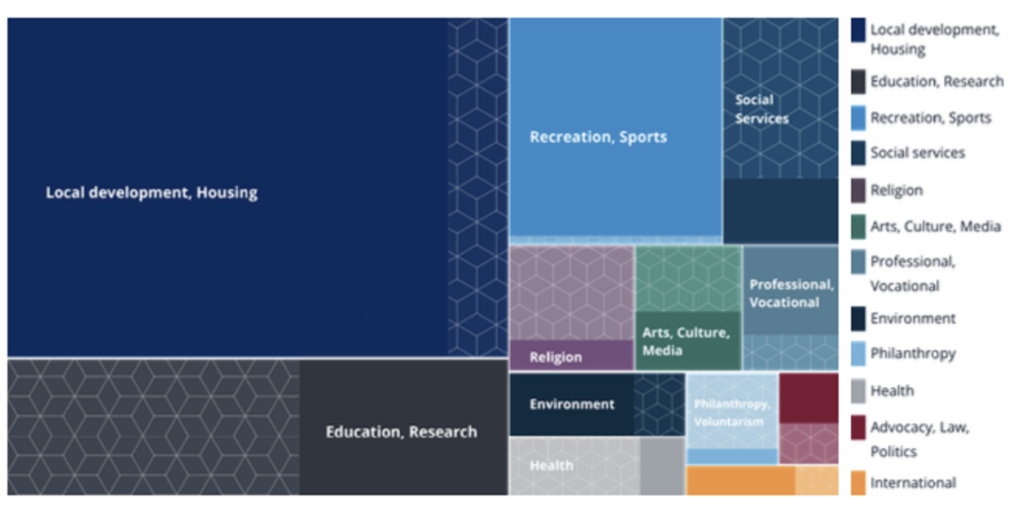
This analysis of how Government directs the net proceeds of the Irish National Lottery to “good causes” is derived from the Who Funds What dataset.